
Knowledge
Planning curtain tracks early in the project
Early planning of curtain tracks reduces conflicts with ceilings, services, facades and other disciplines.
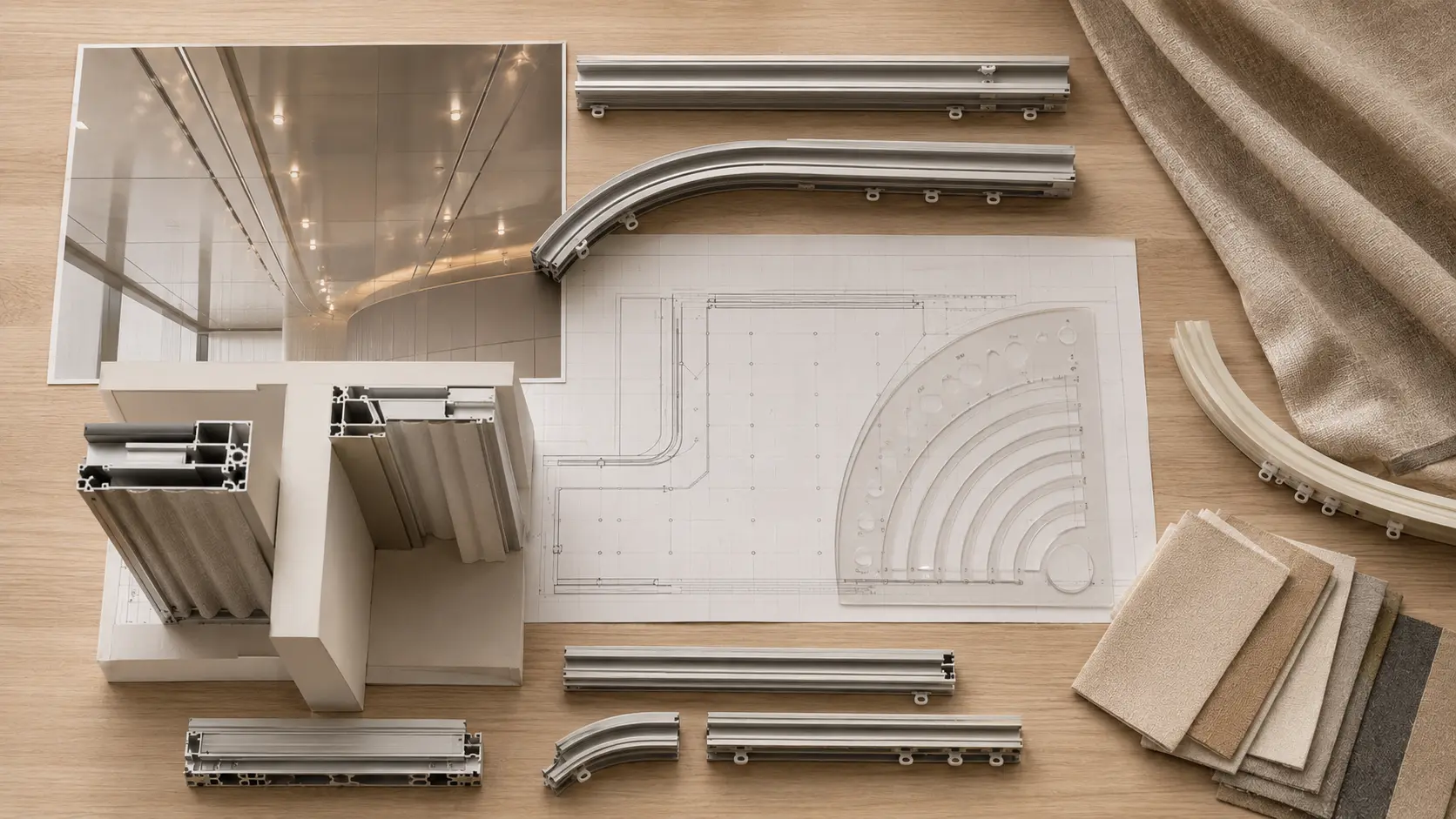
Short answer
Fix the track routing while ceiling details and service zones can still be influenced. Clarify the position relative to glass and fittings, verify that the substrate can carry the load, draw the track line onto the ceiling plan, and plan service and take-down from the start. It is cheap early and expensive late.
Position shapes the whole expression
The track's distance to glass, wall and other tracks determines how the textile drapes, and whether the curtain can pass handles, window boards and services.
The position also decides where the curtain stacks when open — and thereby how much of the window or wall is covered in everyday use.
Fixing must be possible
The substrate must carry the system and the textile. Suspended ceilings may need reinforcement or fixing to the structure behind.
Heavy acoustic and blackout solutions raise the requirements. The fixing principle should be settled before the ceiling design is finalised — retrofitted reinforcement is significantly more expensive.
Coordinate with the other disciplines
Ventilation, sprinklers, lighting, acoustic ceilings, electrical and facade elements can compete for the same zone. A clear track line on the drawing makes the interfaces visible.
For motorised solutions, power and cable routes must join the coordination from the start — see also the article on motorisation.
Think operation and service
Motors, joints and gliders must be serviceable. Also plan how textiles are taken down for cleaning, and whether the system can be adapted later.
Design checklist
- Track lines drawn on the ceiling plan with distances to glass and walls
- Track count clarified for layered solutions
- Substrate and fixing principle verified
- Recesses/pelmets detailed where the track must be concealed
- Service zones coordinated with ventilation, sprinklers, lighting and electrical
- Power prepared if motorisation is relevant now or later
- Access for service and take-down planned
Frequently asked questions
When should curtain tracks be specified and coordinated?
Specify the track position, fixing method and space requirements while the ceiling and building services are being designed. Recessed tracks require the recess, support, clearances and service access to be coordinated from the outset.
What happens if tracks are planned too late?
Typical consequences include inadequate fixing points, clashes with building services and costly on-site alterations. A slim, visible track can be a deliberate design choice and is not in itself a compromise.
How far from the glass should the track sit?
There is no single correct distance. The track must allow the curtain to hang and move freely without touching handles, window sills, radiators or other building elements. Set the distance for the actual window and curtain-heading system.
Can the track be fully concealed?
Yes, in a purpose-designed ceiling recess or pelmet. Allow sufficient space for structural fixing, the curtain's Wave folds, movement and future service. Alternatively, use a slim, visible ceiling-mounted track.
Do you have a specific project?
Upload the material or book a project review with CIS Nordic.