
Knowledge
Can existing curtains be reused?
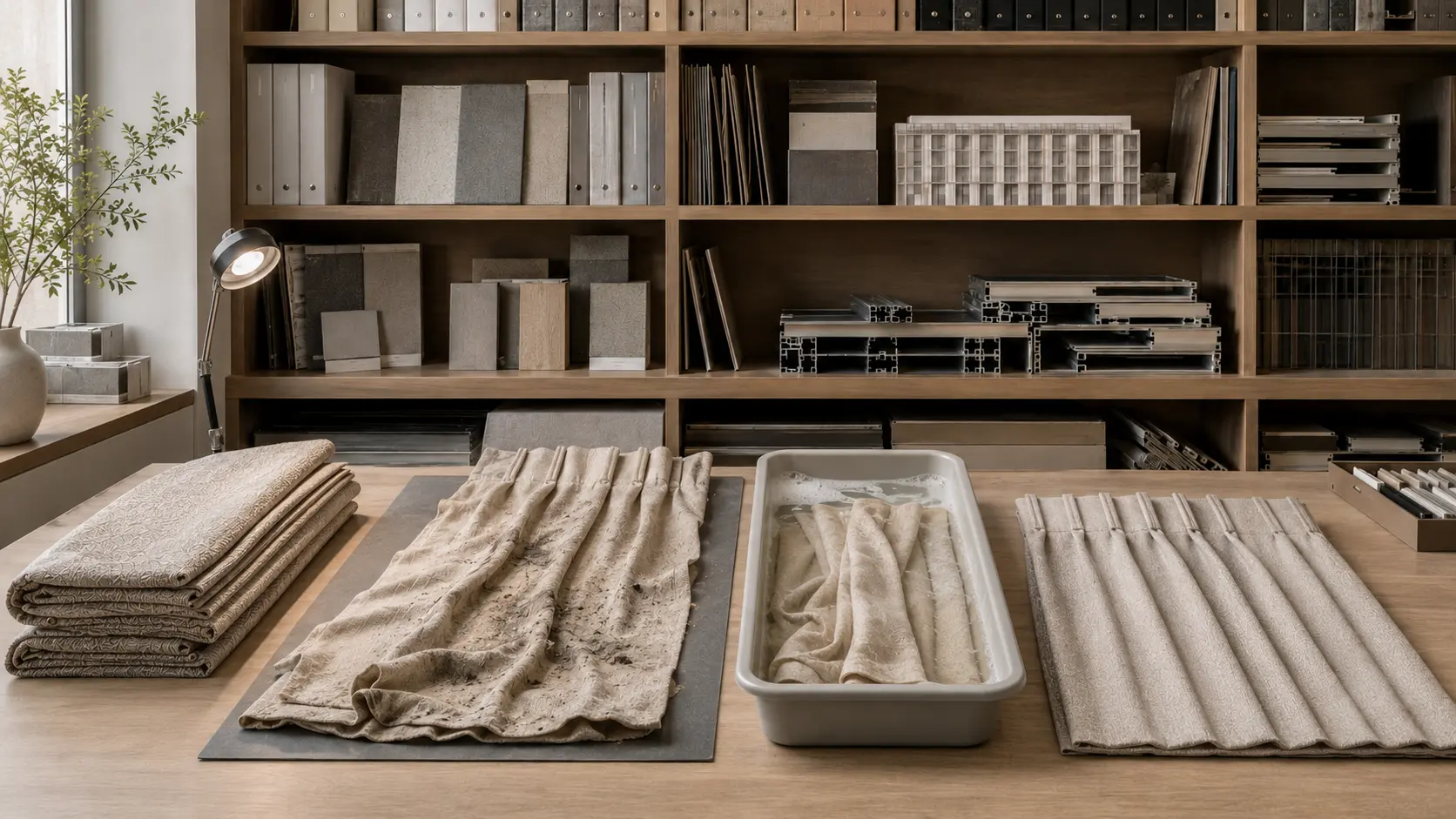
A professional registration can show whether existing curtains can be cleaned, repaired, re-sewn or moved to new rooms.
Short answer
Often yes — but not always, and not all of them. The answer requires a registration of textiles, dimensions, hanging, condition and documentation, which is then held against the requirements of the new use: function, fire classification, aesthetics and cost. Reuse should be examined before everything is replaced, but it must stand on a professional basis.
Begin with a registration
Map textile quality, quantity, dimensions, hanging, colour, condition, damage and existing documentation. The registration should also show which new rooms or functions the textiles are being considered for.
A systematic registration makes it possible to plan panel distribution across rooms — which panels can move where, and what interventions that requires.
Assess function and requirements
A textile can be physically intact yet unsuitable for the new use. Fire classification, transparency, blackout, acoustics, cleaning and aesthetics must fit the new project.
If the fire classification cannot be documented, the assessment considers whether the textile can be used in that room type at all.
Possible interventions
Curtains can in some cases be cleaned, shortened, extended with a new detail, divided, joined, given new heading or moved. Each intervention affects time, cost and the final result.
Compare with replacement
A decision basis should weigh cost, schedule, quality, documentation and expected remaining service life. Reuse is not automatically the best solution, but it should be examined before everything is replaced.
Note that partial solutions are often the best: some panels are reused directly, others re-sewn, and a few rooms get new textiles. The registration makes that combination visible.
The registration should cover
- Quality, colour and any manufacturer documentation
- Number of panels and dimensions per panel
- Hanging type and the condition of the tracks
- Condition: wear, fading, damage, odour
- Fire classification — documented or unknown
- Intended new location and function per panel
Frequently asked questions
When can existing curtains not be reused?
Typically when the condition is too poor, the dimensions cannot be adapted to the new opening, or the required fire performance for the new use cannot be documented. If neither direct reuse nor upcycling is viable, material recycling may be considered. A site survey and condition assessment determine suitability case by case.
Can old curtains be professionally cleaned?
Many curtains can be professionally cleaned, but the method must suit the fibres, care instructions and current condition. Where documentation is missing, consider trial-cleaning one panel first. Cleaning can be combined with repair, alteration and a new heading system where required.
What do reuse and upcycling cost compared with new curtains?
It depends on the work required. Surveying, cleaning, alteration, logistics and reinstallation all carry costs. Compare total cost, required performance and expected remaining service life with an equivalent new solution.
Can the tracks be reused too?
Often, if their condition, number of channels, load capacity, fixing and position suit the proposed solution. Verify these factors during the same site survey and technical assessment as the curtains.
Do you have a specific project?
Upload the material or book a project review with CIS Nordic.