
Knowledge
Curtains as part of room acoustics
Read how textile weight, folding, distance and area affect a curtain's contribution to the acoustic experience of a room.
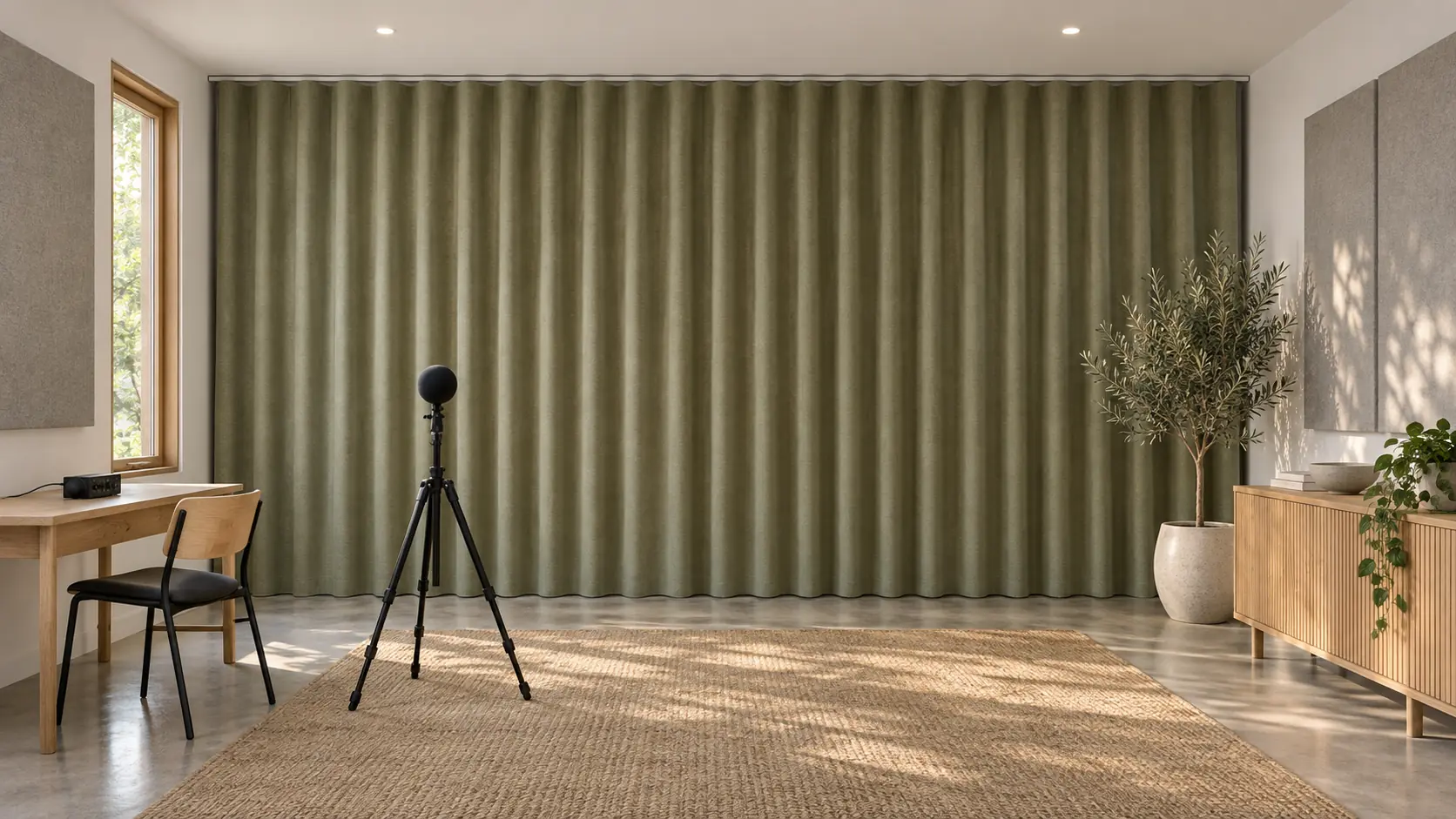
Short answer
Curtains can damp reflections from glass and hard surfaces and make a room more comfortable to be in. The contribution depends on the weight and construction of the textile, the amount of folding, the distance to the surface behind and the total area. Curtains rarely solve a room's acoustics alone — where requirements are defined, manufacturer data and an acoustic assessment must be included.
Textiles reduce reflections
Glass, concrete and other hard surfaces reflect sound. A curtain adds a soft, porous surface that can absorb part of the sound energy and make the room feel less harsh.
In rooms with large glazed areas, the curtain is often the only absorbing surface that can sit directly in front of the glass — where the reflections arise.
Several factors shape the effect
The weight and construction of the textile, the amount of folding, the distance to the surface behind and the total area are central. A heavy, folded curtain with air behind it typically contributes more than a thin, flat textile.
This also means the mounting affects the result: the same textile can contribute noticeably differently depending on fold depth and distance to the glass. Decisions on track position and fullness are therefore acoustic decisions too.
Acoustics is a whole
Curtains can be an important supplement, but do not necessarily solve a room's overall acoustics alone. Ceiling, floor, walls, furnishing, room volume and use must also be considered.
Use documentation for defined requirements
If the project has a defined requirement for absorption or reverberation time, material data and a relevant acoustic assessment must be included. State clearly what the textile documents and what depends on the room as a whole.
Note that documented values apply to a specific quality mounted in a specific way. If fold depth or distance changes, the measured basis cannot be transferred directly.
Decision factors
- What disturbs the room today — reverberation, speech intelligibility or noise?
- How large a textile area can realistically be established?
- Can the curtain be mounted with generous folding and distance to the surface behind?
- Are there defined requirements demanding documentation and acoustic advice?
- Must the textile also solve other needs — screening, blackout, zoning?
Frequently asked questions
How much do curtains improve acoustics?
There is no universal figure. Performance depends on the fabric, installed fullness, air gap, covered area, room size and surrounding materials. Where measurable targets apply, use relevant product test data and a room-acoustic assessment.
Which curtains are best for acoustics?
Choose curtains with documented sound-absorption data for the intended installation. Fabric construction, fullness, the air gap behind the curtain and total area all affect performance, so weight alone is not a guarantee.
Can sheer curtains contribute acoustically?
Some sheer fabrics have documented sound-absorbing properties, while others have only a limited effect. Performance depends on product-specific test data, fullness, mounting, air gap and total area — not on appearance or weight alone.
When should an acoustician be involved?
Involve an acoustician where the project has defined targets for reverberation time or sound absorption, or where noise and speech intelligibility are significant concerns. Curtains are then assessed as part of the room's overall acoustic design.
Where to go next
Do you have a specific project?
Upload the material or book a project review with CIS Nordic.